
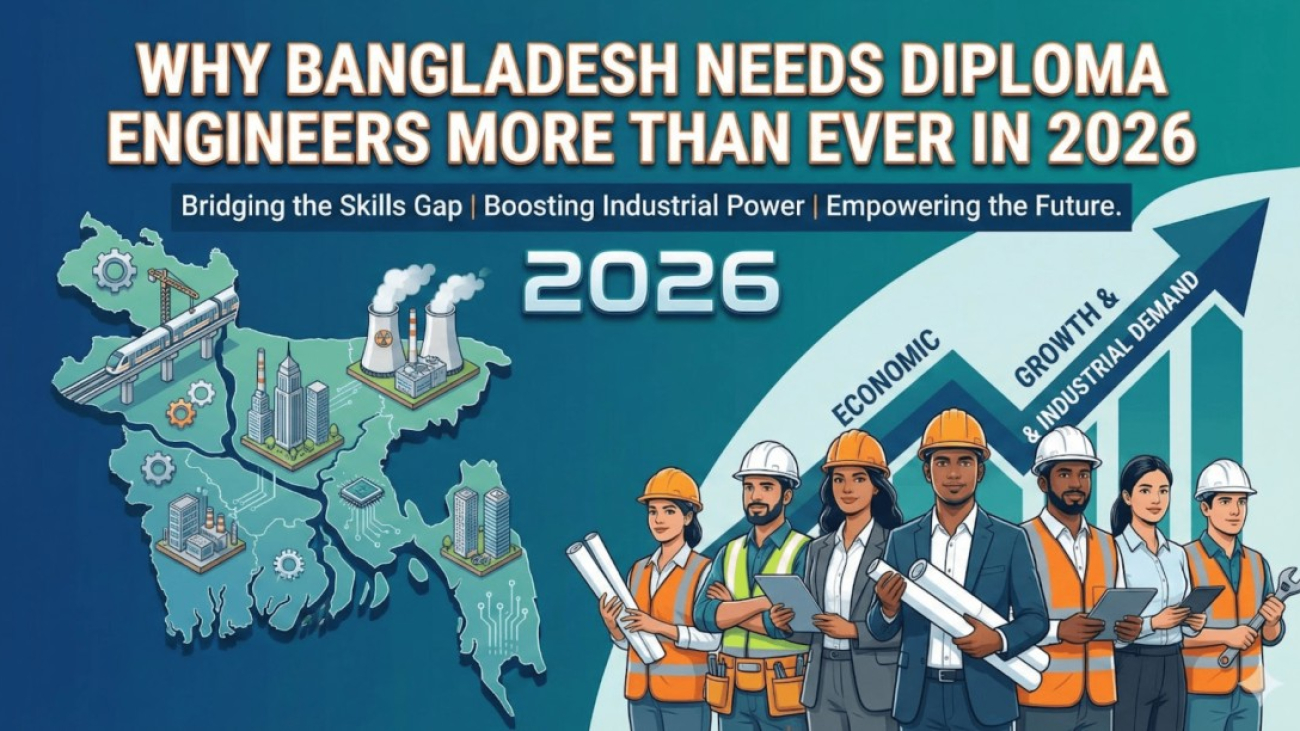
When we think about success in Bangladesh, we often picture a university campus, a convocation hat, and a corporate desk job. But there is another path; a path that builds the bridges we drive on, powers the electricity in our homes, and runs the factories that drive our economy. This is the world of Diploma Engineering in Bangladesh.
For years, many people have looked at the 4-year Diploma in Engineering as a “backup plan” for those who didn’t get into a university. This mindset is not just wrong; it is outdated. Today, as Bangladesh moves towards becoming a developed nation, the demand for skilled hands is higher than ever before.
In this article, we will break down exactly why choosing a technical diploma might be the smartest financial and career decision you can make in 2025. We will look at the salary, the job market, and the incredible opportunities waiting for you, not just here, but across the globe.
What Exactly is a Diploma in Engineering?
Before we talk about jobs, let’s clear up what this course actually is.
A Diploma in Engineering is a 4-year technical certificate offered by the Bangladesh Technical Education Board (BTEB). Unlike a general HSC (Higher Secondary Certificate) where you study theory, a diploma focuses on doing.
You enter a Polytechnic Institute (Government or Private) right after your SSC exams. Over 8 semesters, you don’t just read about how an engine works; you take it apart. You don’t just study electrical formulas; you wire a circuit. This practical approach makes diploma graduates “market-ready” much faster than general graduates.
There are many technologies to choose from, including:
- Civil Technology
- Electrical & Electronics
- Computer & IT
- Mechanical
- Textile Engineering
- Marine Technology
Why Bangladesh needs them “now” more than ever
Bangladesh is in a phase where development is happening across many sectors at once. When growth is fast, the demand for mid-level technical professionals rises sharply.
1. The Construction Wave No One Can Stop
Walk through any district town today and you will see cranes touching the sky. The Padma Bridge is already carrying millions of vehicles. The Dhaka Metro Rail is running. Karnaphuli Tunnel, Rooppur Nuclear Power Plant, Matarbari Deep Sea Port, Payra Port, every project has one thing in common: diploma engineers are on the ground making sure things actually work.
According to the Bangladesh Bureau of Statistics, the construction sector grew by 9.1% in 2023–24 and it is still growing fast. Every kilometer of new highway, every new garment factory, every elevated expressway needs hundreds of civil, mechanical, electrical, and architecture diploma holders. These are the people who read the drawings made by degree engineers and turn them into reality with their own hands.
When the Padma Bridge was being built, everyone praised the design engineers. But the site supervisors who worked in rain and sun, who checked every pile cap, every cable tension, most of them were diploma engineers. Without them, the bridge would still be a beautiful drawing on a computer screen.
2. Factories Are Hungry for Practical Skills
Go to any factory in Narayanganj, Chattogram, or Gazipur. The owners will tell you the same story: “We have plenty of B.Sc. engineers who can make excellent presentations, but we struggle to find diploma engineers who can fix a machine in 30 minutes when production is stopped.”
A textile mill in Savar once lost two days of production because a simple gearbox failed. The degree engineers called the foreign supplier and waited for instructions. A diploma mechanical engineer from the night shift opened it, found the broken bearing, replaced it with a local spare, and restarted the line in four hours. That single repair saved the factory more than 8 lakh taka.
This is not a rare story. This happens every single day in thousands of factories. Bangladesh is now the second-largest garment exporter in the world. We have over 4,500 garment factories and hundreds of new textile, pharmaceutical, food processing, and shipbuilding units coming up. Every one of them needs diploma engineers who know machines by touch, not just by textbook.
3. The Salary Reality That Surprises Everyone
Ask any parent what they want for their child. Most will say “doctor or B.Sc. engineer.” Very few understand that a good diploma engineer today easily earns 35,000–60,000 taka per month within 3–4 years of passing out, and many cross 1 lakh taka with a little experience or overseas job.
In the Middle East, diploma engineers from Bangladesh are in huge demand. A civil diploma holder with 5 years experience can earn 2.5–4 lakh taka per month in Qatar or Saudi Arabia, often more than fresh B.Sc. engineers earn here. And they get there faster because their course is only 4 years instead of 5–6 years (degree + job hunt).
4. The Smart Bangladesh Dream Runs on Diploma Hands
The government says we will be a developed country by 2041. Digital Bangladesh is already here. Smart Bangladesh is the next step. Every smart project needs people who can install and maintain the technology.
Think about the 4G/5G towers going up in villages. Who climbs the tower at midnight when the signal drops? Diploma engineers in telecommunication.
Think about the new solar power plants. Who connects thousands of panels correctly so that electricity reaches the grid? Diploma engineers in electrical power technology.
Think about the automated machines coming into factories. Who programs the PLC and fixes it when it stops? Diploma engineers in electronics or mechatronics.
The World Bank says Bangladesh needs at least 2 million new skilled workers in the next decade. Most of those jobs will go to diploma-level technicians and engineers, not degree holders.
5. The skills gap is real (and it’s holding us back)
Bangladesh has many hardworking people, but industries often say one thing: we need more job-ready technical skills.
Even in everyday life, you can see it. For example:
- A factory buys a new machine but struggles to run it at full capacity because skilled operators/maintenance staff are not available.
- A building installs modern electrical systems, but faults happen because installation and testing were not done properly.
- A construction site loses time due to poor coordination between design, materials, and execution.
These are not “small problems.” They affect productivity, cost, safety, and long-term quality.
This is exactly why strong technical education and skilled diploma engineers matter, because they reduce waste, reduce rework, and increase efficiency.
Where diploma engineers make the biggest impact
Diploma engineers support many sectors, but some areas are especially important in Bangladesh right now.
i) Construction and housing
Urban growth is expanding in Dhaka, Chattogram, Gazipur, Narayanganj, and many other cities. People need apartments, roads, drainage systems, and safe public buildings.
Diploma engineers help with:
- site supervision and measurement,
- quality control of materials (cement, rods, bricks),
- structural checks (basic site-level monitoring),
- plumbing, electrical, and fire safety implementation.
Everyday example: When your home’s water pressure is low or the lift stops frequently, it is often a maintenance and system issue. Good technical supervision during installation reduces these problems later.
ii) Power and energy
Bangladesh is expanding electricity generation and grid systems. Along with big power plants, the country also needs strong distribution, maintenance, and safety practices.
Diploma engineers in electrical and mechanical fields are essential for:
- substation operations,
- power distribution maintenance,
- industrial electrical safety,
- generator, motor, and control panel work.
iii) Manufacturing and garments
The garments sector is a backbone of the economy, and it’s becoming more modern each year with automation, compliance, energy efficiency, and better production systems.
Factories need diploma engineers for:
- machine maintenance,
- production line improvement,
- quality assurance,
- boiler and utility management,
- compliance support (safety, ventilation, electrical load management).
A factory can have great managers, but without strong technical teams, production delays and breakdowns become normal.
iv) ICT and electronics
Bangladesh is growing in software and services, but hardware and electronics support also matters: devices, networks, industrial electronics, automation, and repair.
Diploma engineers can support:
- networking and basic infrastructure,
- electronics servicing and assembly,
- industrial automation support,
- technical customer support and field service.
The Polytechnic Revolution Is Happening Right Now
Bangladesh now has more than 100 government and private polytechnic institutes. The government is adding new seats every year. The Diploma in Engineering course is now under Bangladesh Technical Education Board and the quality has improved a lot.
Many institutes now have modern labs, CNC machines, 3D printers, PLC trainers, autoCAD labs. Students are learning exactly what industry wants.
And the best part? Admission requires only SSC pass. No expensive coaching needed. Total cost for the entire 4-year course in a government polytechnic is less than 25,000 taka. Private ones cost more, but still much cheaper than private universities.
What Parents and Students Must Understand Today
If your son or daughter is good at studies but cannot crack the university admission war, do not think their future is dark. Diploma engineering is not “second choice”—it is often the smarter choice.
In the next 10 years, the boys and girls who choose diploma engineering today will be the ones supervising sites, running factories, earning abroad, and building the Smart Bangladesh we all dream of.
Pro Tip: Employers love practical skills, but a strong resume is key to landing that dream job. If you’re worried about short employment gaps or need to highlight hands-on experience, check out this employment gap resume sample tailored for technical diploma holders. It shows exactly how to showcase your project work, internships, and certifications to stand out.
The country does not need millions of unemployed degree holders. It needs hundreds of thousands of skilled diploma engineers who can get the work done.
Final Word
Every tall building you see, every smooth road you drive on, every garment that leaves our factories and earns dollars, behind all of them are diploma engineers working silently, sweating under the sun, solving problems on the spot.
Bangladesh is rising. And diploma engineers are the backbone of this rise.
If you are a student reading this, consider polytechnic seriously. If you are a parent, stop thinking diploma is less. It is different, and right now, it is exactly what our country needs most.
The future is being built today. And it is being built by diploma engineers.